An architecture is the chosen arrangement of functions, interfaces, and resources (see vocabulary). The point is to compare options against the mission needs, not to start from one.
Three Plausible Architectures
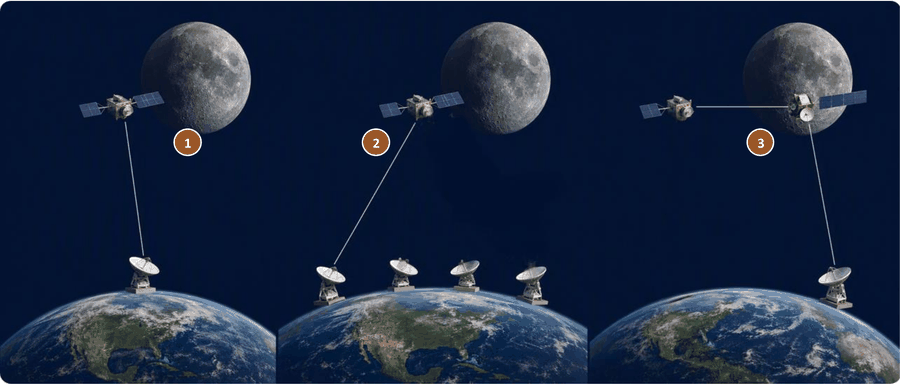
- Mission-owned direct-to-Earth (DTE) ground station
- Shared provider ground-station network
- Relay provider plus direct-to-Earth for bulk data
Architecture Discussion
- Which option meets the mission’s alert deadline? (see the event alert)
- Which uses shared capacity well across missions?
- Which creates the greatest provider dependence?
- Which offers the greatest resilience?
- What do the mission and provider still need to know?
Not Enough Information Is a Result
- Name the uncertainty
- Identify the decision it affects
- Ask for the evidence that would resolve it
NOTE
- Recognizing that we cannot choose yet is engineering judgment
One Link, Two Design Viewpoints
- A single link (spacecraft → ground station) is designed by two different parties:
- Spacecraft team controls: transmit power and antenna, pointing and orbit
- Network provider controls: station antenna and receiver, supported frequencies and scheduling
- In the received-power equation, the spacecraft team owns the EIRP side and the provider owns the receive-gain (later G/T) side
- What a mission should ask a ground provider: questions for a ground-network provider
Mission-Owned vs. Shared Provider
| Mission-owned | Shared provider | |
|---|---|---|
| Structure | One mission ↔ one site | Many missions ↔ many sites |
| Advantages | Direct control, tailored interface, dedicated capacity | Geographic diversity, scalable shared assets |
| Costs | Capital and operations burden, limited geography | Scheduling, interfaces, and service dependence |
- “Does adding a ground station necessarily strengthen this link?”
- Not the link itself: each pass still has its own geometry and budget; a second site changes when and how often contacts happen (geographic diversity), not the received power of a given pass (not on slide)