How positions are described: where the origin is, how the axes point, and what kind of coordinates are used. See also ENAE 441: Reference Frames.
Defining a Coordinate System
- Center: location of the origin
- Center of the Earth / gravitation (orbit center)
- Observation site on the surface
- A satellite
- Orientation: principal (first) axis, polar (third) axis
- For Earth-centered: the polar axis is the north pole axis
- For orbit-centered (perifocal): angular momentum
- Satellite-centered: angular momentum
- Type: Cartesian, polar
- Cylindrical
- Spherical
- Distance
Spherical and Cartesian Coordinates
- Spherical to Cartesian (Matlab
sph2cart, AstroPyspherical_to_cartesian): - Cartesian to spherical (Matlab
cart2sph, AstroPycartesian_to_spherical):- with the two-argument arctangent
- : azimuthal angle in the equatorial plane; : elevation above it
Earth-Centered Frames
- Curtis Fig 1.18: Earth-centered inertial frame and an Earth-centered noninertial frame
embedded in and rotating with the Earth
- along the vernal equinox direction, along the spin axis
- through the Greenwich meridian; a surface point is located by east longitude and north latitude , with a local East / North / Zenith frame drawn at
- Two Earth-centered reference frames:
- Inertial: principal axis is fixed to the vernal equinox
- Rotating (body fixed): principal axis points to the prime meridian
- Celestial sphere (directions in space) vs Earth sphere (points on the ground)
Geocentric Equatorial Frame
- Curtis sec. 4.2
- Geocentric equatorial , also called ECI:
- = principal axis, points to the vernal equinox
- = polar axis
- Equinox, or ascending node (where the Sun crosses the equator going north)
- Polar angles:
- Right ascension
- Declination
- The axes slowly move because of the precession of the equinoxes, nutation, and polar motion (see Precision Reference Frames)
Earth-Centered Earth-Fixed Frame
- ECEF: rotates with the Earth
- Polar angles:
- Longitude
- Latitude
Transformation Between ECI and ECEF
- Sketch: in the equatorial plane, the prime meridian is at angle from , and a local meridian is a further (east longitude) beyond it
- : right ascension of the prime meridian = Greenwich sidereal time (GST)
- : right ascension of the local meridian = local sidereal time
- Transform by rotating between the two frames (about the common polar axis by )
- as a function of time: Sidereal Time
Lunar Coordinate Frames
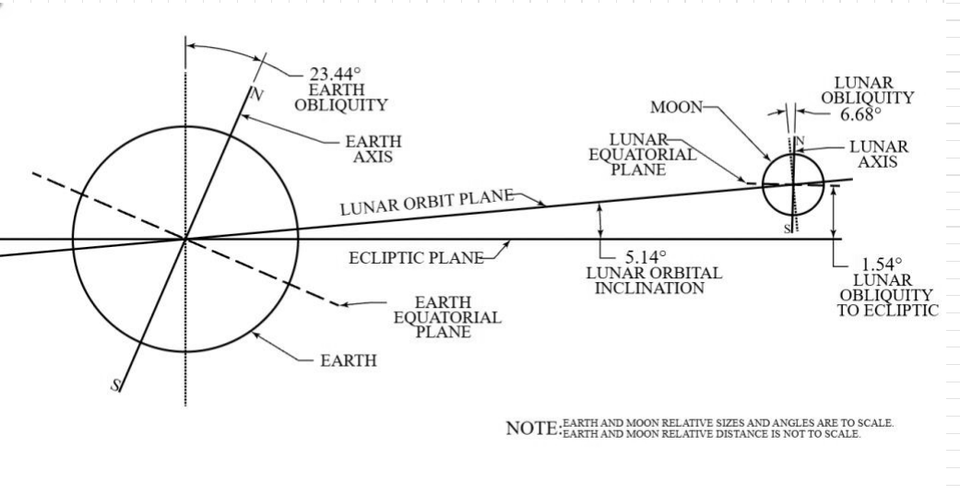
- Earth obliquity ; lunar orbital inclination to the ecliptic
- Lunar obliquity (to its orbit plane), to the ecliptic
- Non-rotating frame: principal axis defined by the cross product of the Earth’s mean rotational pole of J2000 with the Moon’s rotational north pole
- Rotating frames:
- PA: principal axis frame, based on the Moon’s moments of inertia
- ME: mean Earth (older)