Time scales used to tag orbital states and to orient the rotating Earth.
Solar and Sidereal Time
- Solar day: noon to noon, 24 hours exactly
- Sidereal day: one rotation of the Earth relative to the stars (the vernal equinox)
- Sketch: the Earth moves along its orbit around the Sun during one day, so after one full rotation relative to the stars it has to turn a little more to bring the Sun back overhead the sidereal day is shorter than the solar day
- A GEO satellite’s period is one sidereal day
Time
- A time system needs:
- an origin and a unit
- the epoch time of the orbital motion (the time the state or elements refer to)
- Day counts:
- Julian day
- Modified Julian day
- Earth-rotation based:
- UT: universal time
- UTC: coordinated universal time
- UT1: astronomical time (follows the actual rotation of the Earth)
- was previously limited to , engendering the need for leap seconds
- Leap seconds are on their way out, to be phased out officially in ~2035
- Atomic:
- TAI: international atomic time
- TT: terrestrial time,
Sidereal Time
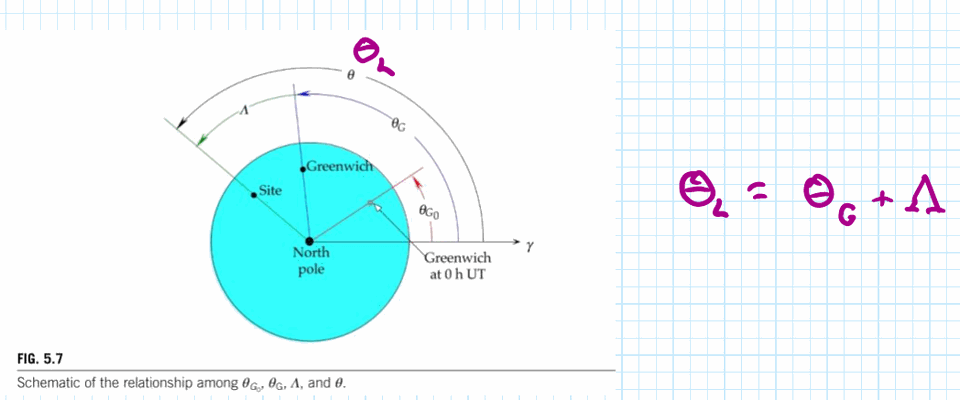
- Curtis fig. 5.7, looking down on the north pole with (vernal equinox) to the right:
- : Greenwich sidereal time at 0 h UT
- : Greenwich sidereal time now
- : east longitude of the site
- : local sidereal time of the site
- In one sidereal day, sidereal time changes by or radians
- that takes
- Used for the transformation between ECI and ECEF
Mean and Apparent Sidereal Time
- GMST: Greenwich mean sidereal time (averaged, mean equinox)
- GAST: Greenwich apparent sidereal time (true equinox)
- Connected by the “equation of the equinoxes”:
- “Mean” vs “true” are defined in Precision Reference Frames