The second conservation law of the Two-Body Problem (Curtis section 2.4).
Conservation of Angular Momentum
- Central force: the force and the acceleration are both along
- Cross with :
- The left side is a total derivative (because ):
Angular Momentum
- is constant, so and always lie in the same plane: the orbit is planar
Kepler’s Second Law
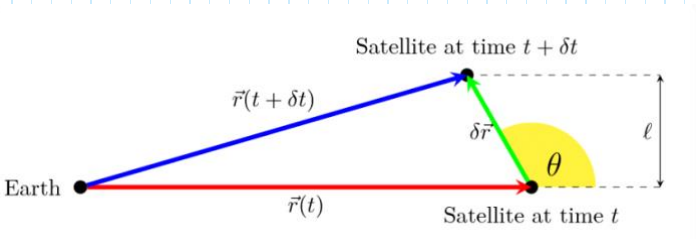
- figure from go.umd.edu/ENAE601-figures
- In a short time the position vector sweeps out a thin triangle with base and height
:
- Rate of sweeping out area:
- Area swept out over a finite time interval from to :
- Equal times equal areas: Kepler’s second law proved
- used again to find the Orbital Period
Transverse Velocity
- Split the velocity into a radial part and a transverse part (perpendicular to )
(Curtis figure 2.9)
- : angle between and
- In time the radius turns through , so the transverse displacement is
- Magnitude of the angular momentum:
- Only the transverse velocity contributes to