Bit Errors and Mission Performance
- Measured BER (bit error rate):
- A theoretical bit-error probability predicts long-run behavior under stated assumptions
One Million Bits
- At , one million bits contains 10 errors on average
- A mission may require frame or packet error performance, not only raw BER (CCSDS 131.0-B-5, TM Synchronization and Channel Coding)
The Ideal BPSK and QPSK BER Curve
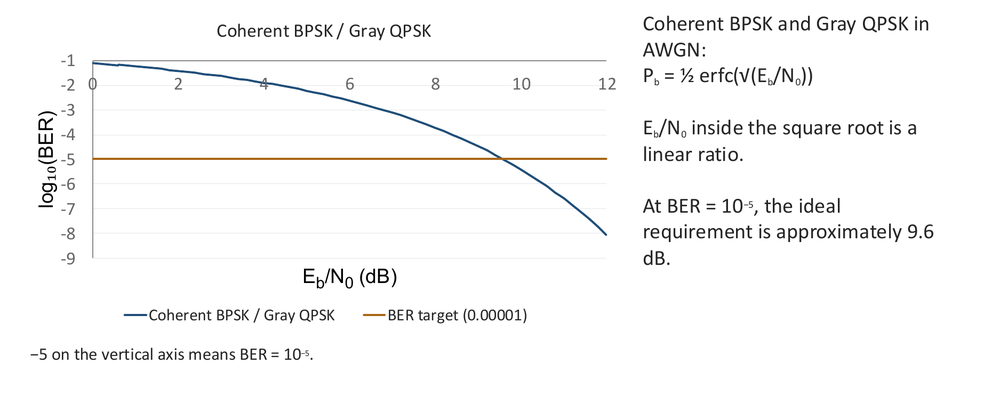
Coherent BPSK / Gray QPSK in AWGN
- inside the square root is a linear ratio
- At the ideal requirement is approximately 9.6 dB
- AWGN = additive white Gaussian noise
- On the plot, −5 on the vertical axis means
- Gray-coded QPSK has the same BER vs. as BPSK (consistent with BPSK vs. QPSK)
Reading a BER Curve
| Ideal uncoded BER | Interpretation | |
|---|---|---|
| 6.0 dB | About 2,400 errors per million bits | |
| 9.6 dB | About 10 errors per million bits | |
| 12.0 dB | Far fewer errors under this ideal model |
- Coherent BPSK, AWGN, perfect synchronization; actual equipment adds implementation effects
- Reference: MathWorks, Analytical Expressions Used in berawgn Function and Bit Error Rate Analysis App
Available vs. Required
- The curve gives the required ; the link budget gives the available (Energy per Bit)
- The difference, after implementation loss, is the margin
Pulse-Shape Mismatch
| Receive filter | Required at |
|---|---|
| Matched root-raised-cosine filter | 9.6 dB |
| Rectangular integrate-and-dump filter | 10.5 dB |
| Additional required | About 1.0 dB |
- Teaching calculation (optional slide): uncoded BPSK, RRC transmit roll-off 0.35, AWGN, perfect carrier/timing, independent bits, no equalizer
- The penalty is specific to these assumptions — a receive filter that doesn’t match the transmit shaping costs required
Further Reading
- Coding (next class) lowers the required (what if the link still does not close?); Class 5 further reading: CCSDS 130.1-G-3 (2020), TM Synchronization and Channel Coding — Summary of Concept and Rationale; MIT 6.450 Lecture 23, channel capacity and the wideband energy limit