The orbit in (any) time: connecting the mean anomaly (linear in time) to the true anomaly (geometry) through the eccentric anomaly. See also ENAE 441: Kepler’s Equation.
Mean Anomaly as a Function of Time
- From any epoch (not only perigee):
Kepler’s Equation
- The area swept out since perigee, in terms of the eccentric anomaly :
- Substitute into the areal definition of the mean anomaly:
Kepler's Equation
- Easy direction: . Given (from time), solving for requires iteration
Eccentric and True Anomaly
- Position in terms of (Cartesian, origin at the focus):
- Expand:
- Take the square root:
Radius-Eccentric Anomaly Equation
- Equate with the orbit equation ():
- Relations between and :
- Quadrant-safe forms with the two-argument arctangent:
Half-Angle Relations
- Half-angle identity:
- Applied to with (3.10b):
- and are always in the same quadrant, so
Half-Angle Tangent Relations
From True to Mean Anomaly
| Anomaly | Nature | Step to the next | |
|---|---|---|---|
| True | Geometric | half-angle tangent relations: | |
| Eccentric | Intermediate | Kepler’s equation: | |
| Mean | Dynamic |
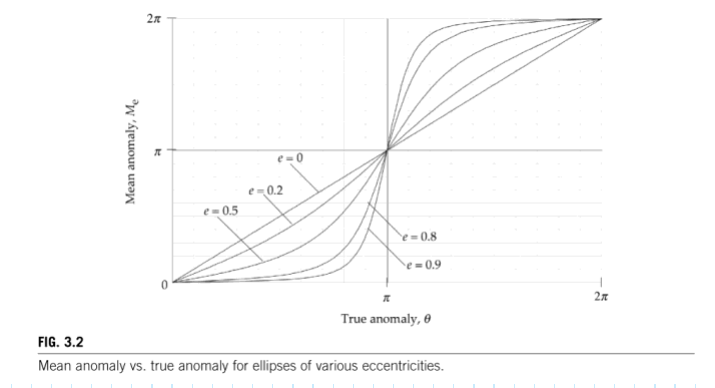
- Curtis Fig. 3.2: vs for
- : a straight line ()
- Larger : changes slowly near perigee (, fast motion) and very quickly near apogee (, slow motion)
Hyperbolic Orbits
- (or ) = hyperbolic anomaly,
- Radius:
- Relation to the true anomaly:
- Mean motion:
- See Hyperbolic Orbits
Parabolic Motion
- Parabolic anomaly:
Barker's Equation
- : radius of perigee
- All three cases (ellipse, parabola, hyperbola) are unified by Universal Variables