Parabolic and hyperbolic trajectories: conic sections with that never return.
Energy of the Conic Section
- The sign of the specific mechanical energy classifies the orbit:
- : bound orbits (circle, ellipse)
- : parabolic
- : hyperbolic
- applies to the bound orbits, not to the parabola ( is not defined)
- For the hyperbola, (with taken positive; equivalently with )
Parabolic Orbits
- Curtis section 2.8
- Eccentricity ; semimajor axis not defined
- Orbit equation:
- Perigee radius, with the semi-latus rectum:
No semimajor axis
- The ellipse formula does not work for a parabola (crossed out in the notes): is undefined and ; use
- Energy is zero:
- as , : the parabola is the trajectory that just barely escapes
- So the speed at radius on a parabola is the escape speed:
Escape Speed
- Compare the circular speed :
Hyperbolic Orbits
- Curtis section 2.9
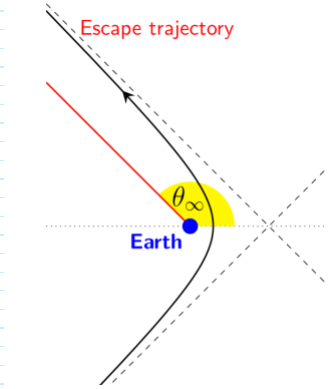
- , so : the focus (Earth) is farther from the center than the vertex is
- Solve the orbit equation for the true anomaly:
- As the trajectory approaches its asymptote at the true anomaly of the asymptote :
- the true anomaly is limited to
Hyperbolic Excess Speed
- Far from the Earth () the potential energy vanishes and the speed tends to :
Hyperbolic Excess Speed
- The speed left over after escaping
- Anomalies for these orbits (hyperbolic anomaly, Barker’s equation): Kepler’s Equation