Rewriting the Orbit Equation in Cartesian coordinates shows every two-body orbit is a conic section (Kepler’s first law). See also ENAE 441: Geometry.
Cartesian Form
- Put the origin at the focus (Earth) with aligned with the direction of the
eccentricity vector:
- The orbit equation becomes
- Eliminate :
- Define the semimajor axis
- Substitute :
Equation of Conic Section
- Center at : the focus (Earth) is a distance from the center
Classification by Eccentricity
| Conic | Eccentricity | Notes |
|---|---|---|
| Circle | radius | |
| Ellipse | is the semimajor axis | |
| Parabola | not defined, see Parabolic Orbits | |
| Hyperbola | see Hyperbolic Orbits |
Ellipse Geometry
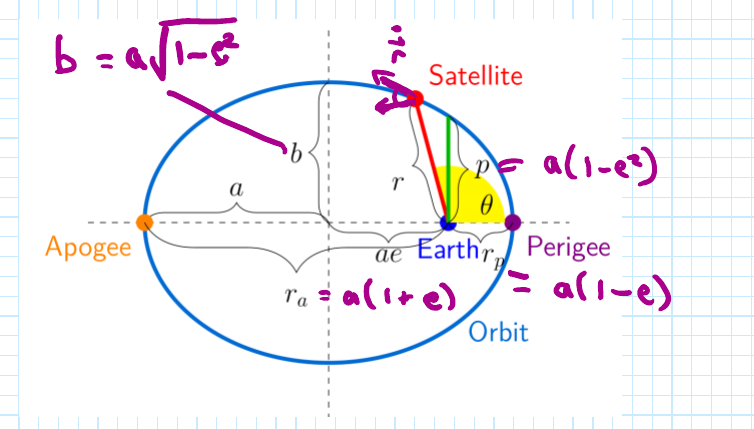
- Semiminor axis:
- Semi-latus rectum (radius at ):
- Perigee and apogee radii ( and ):
- Focus-to-center distance ; the Earth sits at the focus nearer perigee