Stability and convergence of the homogeneous (“internal”) solutions , stated with norms.
Motivation
- Stability and convergence of homogeneous solutions
- In simple LTI/SISO, the condition is
- for all ICs all poles in LHP
- To generalize such ideas to vector functions, we’ll use vector norms
- Use these notions to describe stability / boundedness / convergence, first of the state eq’n, then of input/output behavior
- Example: such that
- or as
Stability in the Sense of Lyapunov
- More formally, a system is stable i.s.L. (“in the sense of Lyapunov”) if such that
- Note
- the system is stable i.s.L. if
- i.e. is bounded
- The system is asymptotically stable if as
- as
- How to deduce whether has these properties if we don’t know exactly what looks like? Lyapunov Functions
Formal Definitions
Stability and Uniformity
- Stable (i.s.L.): if so that
- If we can find a single , independent of , that works for all , the stability is said to be “uniform”
Example where γ depends on t₀
- With (), the solution for reaches a max at , for which
- grows without bound as increases, so this stability cannot be uniform
Possible slip in notes
- The coefficient reads , but the stated ratio is what gives for , so the "" inside the sine may be a slip
Asymptotic Stability
- Asymptotic stability:
- stable i.s.L., and
- as
- Why require condition 1 as well? Sketch: starting from at could blow up, as (finite escape time), and then still decay to 0 afterward; condition 2 alone would not rule this out
- Condition 2 can be expressed as: for any , so that
- If a single can be found that works for every , the system is said to be uniformly asymptotically stable (UAS)
- Note: will still depend on !
Asymptotically Stable but Not Uniformly
- Linear system with fundamental solution and STM
- so
- The system is A.S. Is it UAS?
- Suppose we take . Then we need to find such that
- If
- If : , so
- Not uniformly asymptotically stable
- Generally here must satisfy
- ( depends on both and !)
Exponential Stability
- Exponentially stable: if and such that
- Sketch: may wiggle up and down, but it stays under a decaying envelope
- ES is uniform (UES) if both and are constants, independent of
UAS Implies UES for Linear Systems
- Note: ES AS, but the reverse is not generally true
Theorem
- For linear systems it is true that UAS UES
- Proof: recall
- UAS so that
- Chop time into intervals of length : , , etc.
- For :
- For (using the composition property):
- For :
- For :
- as if
- For :
- Say for illustration:
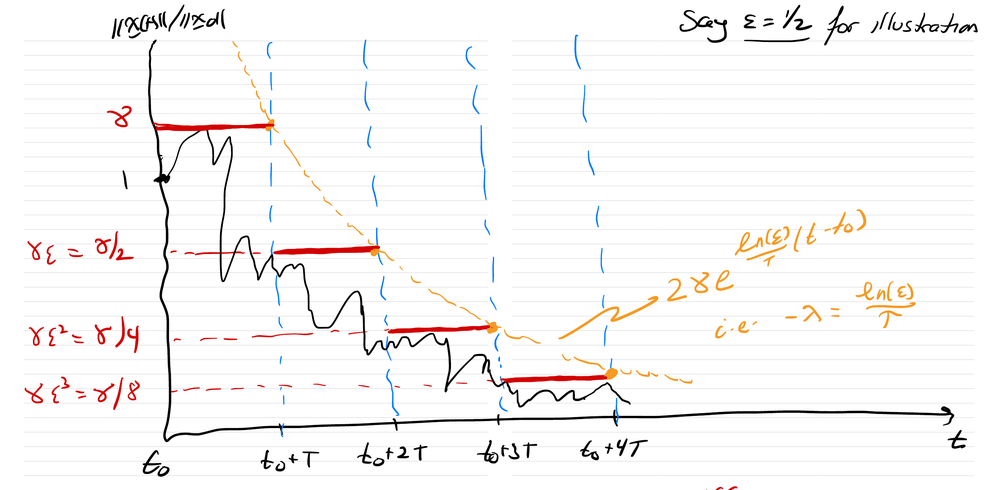
- The staircase bounds lie under the exponential envelope , i.e.
- Thus UAS (equal contraction, , on equal time intervals, )
UAS ⇒ UES
- and describe the asymptotic stability properties of the system